|

|
|
|
Greetings, Utah Energy United!
Perhaps the activity that is most universally dreaded in a group setting is the icebreaker exercise. No one ever starts a story with, “Hey, I went on a corporate retreat, and my favorite part was the icebreaker exercise! I love giving myself anxiety trying to think up an ‘interesting fact’ about myself! What fun!” Well, that changes now because here’s the greatest icebreaker question of all time:
We’re going on a road trip and we’re at a gas station and you get to pick one salty snack, one sweet treat, and one beverage. What are you getting?
For those of you doubting the greatness of this question, go ahead and ask it to your family tonight at dinner and see what their responses are. I can virtually guarantee the answers you get will not only be illuminating, they’ll be delivered with a level of enthusiasm you didn’t anticipate. It’s an incredible question. For me: An extra sharp cheddar cheesestick with dilly bites, Sour Patch Kids, and a tallboy of Arizona Iced Tea.
We thought of this because we’re in what feels like the dead center of summer, and peak driving season. That, combined with the perpetual tumult surrounding the Strait of Hormuz, means consideration of gas prices will necessarily follow. Crude oil prices have fallen, and as of this week, Utah’s gas prices have remained within five cents of the national average. This is relief relative to where prices have been, but we fear there will be a correction coming for a number of reasons.
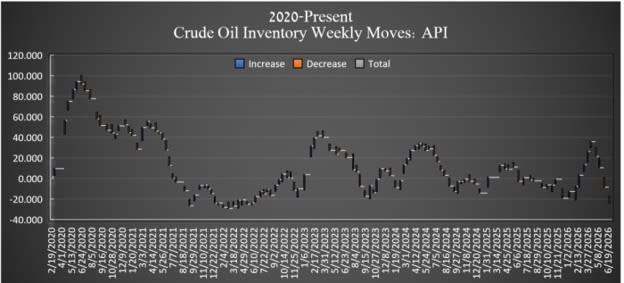
First, inventories are very, very low. According to this article from OilPrice.com, “The American Petroleum Institute (API) estimated that crude oil inventories in the United States fell by 399,000 barrels in the week ending July 3. In the week prior, US crude oil inventories fell by 6.072 million barrels.” Furthermore, “Gasoline inventories fell this week, by 2.929 million barrels in the week ending July 3. In the week prior, gasoline inventories decreased by 2.106 million barrels. In the week prior, gasoline inventories were already 7% below the five-year average for this time of year, according to the latest EIA data.” Take a look at this chart, which should provide easier-to-visualize context: |
|
|
Second, and speaking of the Energy Information Administration, according to their analysis, United States refining capacity has also dropped this year. “U.S. operable atmospheric distillation capacity, the primary measure of refinery capacity, totaled 18.2 million barrels per calendar day (b/cd) on January 1, 2026—down over 250,000 b/cd (about 1%) compared with January 1, 2025—according to our latest annual Refinery Capacity Report.” The report lists 130 operable refineries, two fewer than in 2025. And while some of that capacity was offset by expansion in some facilities, the closure of one Houston refinery and Phillips 66’s Los Angeles facility removed about 400,000 b/d from the market. For further context on the outsized impact California refining has on the sector as a whole, here’s more from the EIA:
The Phillips 66 Los Angeles refinery reflects a relatively small share of total U.S. refinery capacity, but its closure marks a 5% reduction in refinery capacity on the West Coast (PADD 5). Valero’s 145,000 b/d Benicia refinery is still included in the report, as it was still operational as of January 1, 2026. However, that refinery has also ceased refining operations, and its capacity was removed from our monthly capacity estimates as of March 2026. Relatively little pipeline capacity exists to supply petroleum products from large refinery hubs on the U.S. Gulf Coast to the West Coast, which means reductions in refinery capacity on the West Coast can have a larger impact on fuel availability in the region compared with other regions in the United States.
Since Utah’s five refineries are the #1 fuels supplier in PADD 4, adjacent to PADD 5 where product moves between the two, and are running at full capacity, the squeeze is felt locally even more intensely.
And third, the conflict in Iran has resulted in the loss of over a billion barrels of oil supply, according to this article in Hydrocarbon Processing. And while the world has demonstrated remarkable resolve in absorbing that loss – the biggest energy disruption in history according to the International Energy Agency – with long-term peace elusive and buffer reserves now drained, it still faces the looming risk of future price spikes. From the article: Replenishing oil stocks, never cheap, has likely been made more expensive by the war. Before the conflict, the European Central Bank had estimated 2027–2028 oil prices at $63 to $64 per barrel. That's now risen to an average of $65 to $75, according to an ECB report published in June.
At current Brent prices, it would likely cost more than $70 billion to replace reserves drawn down to mitigate Iran war supply loss.
But until that is done, the world is operating without a safety net in an environment still fraught with uncertainty.
That uncertainty persists. As you’ve likely seen, Iran has claimed credit for attacking commercial shipping vessels, and earlier this week President Trump declared the ceasefire over as tensions and hostilities continue. The situation shows no signs of finding permanent resolution anytime soon.
Considering the United States needs to replenish its own Strategic Petroleum Reserve, which is at its lowest level since 1983 (you can find that data here), we’re using this space to encourage you not to be surprised if crude oil prices, and by extension gasoline prices, experience future volatility. Obviously, no one knows what lies ahead, but we want to ensure everyone reading this is clear-eyed about the root causes of potential price spikes.
We hope the summer finds you enjoying time with family and friends and hitting the road to experience Utah’s abundant natural beauty. We will be sure to keep you apprised of what we know and what we can anticipate coming to the best of our ability. Until then, please pass me some Sour Patch Kids.
Thank you for your continued engagement with Utah Energy United. Happy Friday!
Be sure to follow us on X, Facebook, and LinkedIn. And if you know someone who should be a part of Utah Energy United, get them to sign up here.
Rikki Hrenko-Browning |
|

|
Thank you for your many efforts! |
|


