|

|
|
|
Greetings, Utah Energy United!
In last week’s dispatch, we discussed the growth of renewable energy (notably solar), but offered the caveat its relative share of the overall energy picture was still pretty small. This remains true, but some additional context here is likely useful.
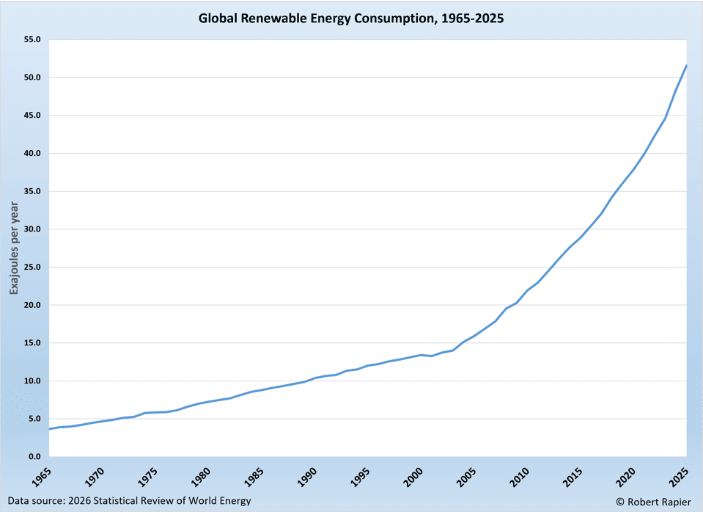
A recent article in Forbes by Robert Rapier – who, spoiler alert! will speak at our October Lunch & Learn on October 27 – is titled “Renewables Are Booming. So Why Aren’t Fossil Fuels Declining?” In it, Rapier discusses writing about solar energy nearly two decades ago about its future potential and how that future is now. He provides this chart demonstrating global renewable energy consumption: |
|
|
Impressive! Here’s more: Solar generation jumped 30.1%. Wind increased 8.2%. Other renewables grew 2.8%, while hydroelectric generation edged up just 0.4%.
Measured by the actual increase in electricity generated, solar accounted for nearly three-quarters of the growth in renewable electricity during the year.
You’d think with a consumption rate that has increased 10x over the last 60 years that renewables would displace traditional forms of energy. That’s been the stated goal of environmental activists and renewable energy boosters for as long as we can remember. And it’s possible some of the traditional energy sources have been displaced on a regional basis, but they can never fully be replaced. Why? Well, see for yourself:
There is an important qualification to all of this impressive renewable growth. In 2025, renewable energy supply increased by about 3.2 exajoules. But total global energy demand increased by roughly 8.1 exajoules.
In other words, renewables supplied only about 40% of the increase in global energy demand. They are growing rapidly, but global energy consumption is growing even faster. As a result, the expansion of renewables is still primarily adding new energy supply rather than displacing existing fossil fuel consumption.
This is why we remain advocates for all-of-the-above energy strategy. Demand isn’t going to decrease, it’s only going to increase unless humanity suddenly develops a taste for lifestyle regression, which seems extremely unlikely; or there’s some sort of technological breakthrough that serves as a total paradigm-shifting panacea for our energy needs, which also feels very unlikely.
Unless either of those dubious propositions radically alters how we consume or produce energy, the most prudent approach is to be a champion for energy of all types. We need more solar (and a modern grid that can handle its rapid voltage and frequency fluxes)! We need more hydroelectric, which is noted by Rapier as the largest renewable source of power in the world! We need more nuclear (and are excited by Utah’s inertia in that regard)! And, germane to our purposes, we continue to need more oil and natural gas. That doesn’t seem likely to change anytime soon.
You can read Rapier’s entire article in Forbes here. You can check out all of our Lunch & Learns here.
Thank you for your continued engagement with Utah Energy United. Happy Friday!
Be sure to follow us on X, Facebook, and LinkedIn. And if you know someone who should be a part of Utah Energy United, get them to sign up here.
Rikki Hrenko-Browning |
|

|
Thank you for your many efforts! |
|


