|

|
|
|
Greetings, Utah Energy United!
How much is the Iran war costing Utahns? That’s the question posed in the headline of a recent Salt Lake Tribune article, which you can find here. The numbers are eye-popping with a topline figure of $43.6 billion according to an estimate from the Pentagon spread across operational costs, munition costs, and equipment losses. Adding in debt servicing, estimated future costs, and medical expenses for those who participated in the war, the Tribune estimates a total of $95 billion.
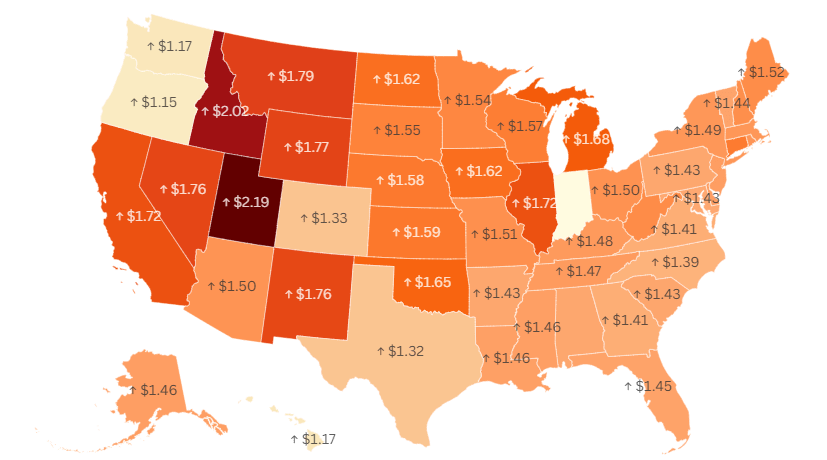
As taxpayers, we all get a share of that. Using some basic math, the Tribune puts the estimate at an average of $744 for each Utah household. A staggering sum to be sure, but beyond those direct costs, the article looks at the disruption of fuel markets thanks to the reduced ship traffic through the Strait of Hormuz, which results in higher retail gasoline prices for all motorists. Check out the chart below and check out which state has been hit the hardest: |
|
|
Yep. Utah is #1! It’s a dubious honor, to be sure, but also an important dose of reality that underlines what we’ve been saying for months about how actions from so far away can have a profound impact in our own backyard, no matter what we do – whether that’s a gas tax holiday, maximizing drilling, or anything else. Some things are simply too big in scope to account for, and the perfect storm of the Iran war, Russian-Ukranian hostilities, and a global (and Western US) refining sector stretched too thin is one of them. We haven’t even talked about the increase in diesel prices yet, so let’s do that.
When people are feeling the pressure of accounting for higher prices across the board, it’s natural for those in charge to want to do something. According to an email alert from our colleagues at Energy Marketers of America, “President Trump [earlier this week] signed an Executive Order, ‘Emergency Tax Relief on Diesel Fuel,’ intended to provide temporary relief from high diesel fuel prices. The Order directs the Treasury Department to provide conditional federal excise tax deferral and specified penalty relief for highway sales and use of dyed diesel from October 5 through December 31, 2026.
“The White House estimates savings of about $60 on a 250-gallon fill up from the 24.4 cents-per-gallon federal tax, and more than $100 per fill up where states also suspend their fuel taxes. The Agriculture Department (USDA) estimates approximately $640 million in combined federal and state savings across approximately 224.6 million harvested acres.”
We’re hopeful this tactic brings much-needed relief to the trucking industry that is the lifeblood of how the vast majority of goods are transported in this country, which, in turn, will hopefully alleviate the current and looming prices increases on us all.
An idea we hope the Administration does not consider is a diesel export ban, as the President has mentioned several times. An exceptional piece titled “Leap of Faith – Potential Plans to Limit U.S. Diesel Exports Come With Plenty of Downside Risk” from RBN Energy does an exceptional job of breaking down the reasons such a move would ultimately backfire.
The thinking behind an export ban is that by limiting the market, the oversupply would result in lower consumer costs. But due to the particulars of the U.S. refining industry, the impact would be mildly positive in the short term, and extremely negative in the long term. From the article directly:
With an export ban in place, U.S. diesel prices could have a two-stage trajectory. Retail diesel prices would initially move lower as inventories rose. But once refiners started to cut diesel production, the inventory build would start to slow and diesel prices would likely recover from their initial lows, although not necessarily back to today’s levels. It’s also important to remember that refiners cannot stop making diesel without also affecting gasoline, jet fuel and other products, so any move to shift yields away from diesel would impact other fuels too, potentially pushing up prices for those products even as diesel prices moved lower. As such, gasoline prices would likely increase considerably, especially once U.S. refiners start to cut throughput rates. California (which, as mentioned earlier, has also become a net exporter of diesel due to renewable mandates) and the surrounding states would likely be the first to feel this impact and would probably see the largest increase in gasoline prices, due to the high cost of long-haul imports necessary to replace the supply lost from refinery cutbacks.
Considering California’s existing shortfalls already pulls Utah’s product even further west, which drives up prices, an export ban would mean that not only California, but Utah, would be one of the first and most directly hit by it. Put another way, an export ban would amplify already-existing issues from California’s misguided management of its own industry.
The ripple effects would then likely move far beyond our borders, which would then also exacerbate the problem across the world due to the constricted supply putting upward pressure on prices of all refined products. Furthermore, the article describes how such a move could undermine the economics of future refinery investment and upset our longtime trading partners. At first blush, an export ban looks attractive, but once one digs into the cold, hard data behind it, one quickly surmises it’s a non-starter. And thus, we hope that’s not a path that’s chosen.
No matter which way you look at it, it’s a challenging environment largely stemming from the United States’s actions in Iran. Until this situation reaches a more stable resolution, the challenges will likely continue. We will continue to monitor this and other items of interest, and, as always, do our best to give you the most clear-eyed analysis we can.
Thank you for your continued engagement with Utah Energy United. Happy Friday!
Be sure to follow us on X, Facebook, and LinkedIn. And if you know someone who should be a part of Utah Energy United, get them to sign up here.
Rikki Hrenko-Browning |
|

|
Thank you for your many efforts! |
|


